

At-Home Sleep Study vs. Lab Sleep Study: Which Is Right For You?
Compare home sleep apnea testing and laboratory sleep studies, including suitability, costs, equipment, and what happens after an inconclusive result.
By EASYLONGER · Jan 2, 2025 ·
Quick answer: Use this guide for education and for preparing questions for your clinician. Sleep-apnea symptoms, diagnosis, PAP settings, and treatment decisions should be reviewed with a qualified healthcare professional.

Millions of Americans suffer from sleep apnea, a condition that often goes undiagnosed. If you’re experiencing symptoms like loud snoring, persistent fatigue, or frequent headaches, sleep apnea could be the culprit. One of the most effective ways to confirm a diagnosis is through a sleep study. But should you choose an at-home sleep test or head to a sleep lab? In this guide, we’ll compare both options to help you decide which is best for your situation.
How Sleep Apnea is Diagnosed
If you suspect you have sleep apnea, the next step is to get a proper diagnosis. Doctors generally recommend a sleep study, either at home or in a sleep lab. The traditional option is a polysomnography (PSG) study conducted in a lab, but with advances in technology, home sleep tests (HSTs) have become increasingly popular.
While a lab sleep study offers comprehensive diagnostics, a home sleep test can be a convenient and affordable alternative for those primarily concerned with Obstructive Sleep Apnea (OSA). Here, we will break down the differences between these two methods and explore which one might be the most suitable for you.
In-Lab Sleep Study vs. At-Home Sleep Study: A Comparison
Diagnostic Capabilities
An in-lab sleep study records more signals, such as brain activity, breathing, oxygen levels, heart rate, and movements. It can help assess breathing and other sleep disorders; some conditions require additional tests rather than a single overnight study.
On the other hand, a home sleep test primarily focuses on diagnosing OSA. Although it’s less detailed than a lab study, a home test is still highly accurate in diagnosing Obstructive Sleep Apnea, particularly for individuals without other complicating health issues. The American Academy of Sleep Medicine (AASM) recommends home sleep testing primarily for people who are at risk of OSA and already display symptoms, rather than as a general screening tool.
Who Should Choose Which?
For an uncomplicated adult with symptoms suggesting moderate-to-severe OSA, a clinician may order a home sleep apnea test. If that test is negative, inconclusive, or technically inadequate, an in-lab study may still be needed. The choice follows a clinical evaluation rather than convenience alone.
However, if you have a complex medical history or require a more thorough assessment, such as if your doctor suspects you have Central Sleep Apnea or another related condition, an in-lab study may be necessary. People with a history of significant medical conditions, such as neuromuscular diseases or chronic lung conditions, will benefit from the comprehensive nature of a lab sleep study.
Testing Equipment: Home vs. Lab
The equipment used in both types of sleep studies is also quite different. In a lab study, you’ll be hooked up to numerous sensors placed on your scalp, chest, legs, and face to monitor a wide variety of bodily functions while you sleep. You’ll also have a nasal cannula for airflow and a pulse oximeter to measure blood oxygen levels.
Home sleep testing uses a portable device that records selected breathing and oxygen-related signals; the exact sensors vary. Follow the supplied fitting instructions and contact the testing service if a sensor comes loose.
Cost Comparison: Home Sleep Study vs. Lab Sleep Study
Costs vary by provider, location, insurance network, and the tests included. Ask for a written estimate covering the test, interpretation, and follow-up, and confirm your expected out-of-pocket amount with your insurer.
A home sleep apnea test often uses fewer resources than an in-lab study, but the price and coverage depend on the service. Compare the complete estimate, and ask whether a further lab study would be needed if the home result is inconclusive.
Comfort and Convenience
Comfort plays a huge role in the quality of your sleep during a sleep study. In a lab, you’ll be in an unfamiliar setting with electrodes and wires attached to various parts of your body. Many people find this environment uncomfortable, which can affect the accuracy of the test results.
Home testing lets you sleep in your own bed with a portable monitor. This can be more convenient, but it does not make the result inherently more accurate than laboratory testing. Correct sensor placement and clinical interpretation still matter.
Time Commitment: How Long Do Sleep Studies Take?
Some studies are completed in one night, while others need repeat or additional testing. Ask your testing service how many nights to record and when a clinician will review the results.
Results: How Long Does It Take to Get Your Diagnosis?
After the test, ask when the results will be reviewed, how you will receive them, and whether a follow-up appointment is already arranged. Turnaround depends on the testing service rather than being guaranteed by home or laboratory location.
Final Thoughts: Which Test Is Right For You?
Both home and in-lab studies have useful roles. The appropriate test depends on your symptoms and health history. A sleep clinician can determine whether a home test is suitable or whether the more extensive monitoring of a laboratory study is needed.
Regardless of which method you choose, diagnosing sleep apnea is the first step toward getting the treatment you need. If you’re experiencing symptoms like excessive daytime sleepiness, loud snoring, or trouble concentrating, it’s a good idea to talk to your healthcare provider about your sleep health and explore your testing options.
When to involve your care team
Contact your sleep clinician or equipment provider if symptoms continue, your mask leaks, treatment feels uncomfortable, or you are considering pressure or therapy changes. Do not use a blog post as a substitute for diagnosis or individualized medical advice.
Continue learning
Review the sleep-apnea library and the CPAP-therapy library for related education and practical questions to discuss with your care team.
Run the numbers for your CPAP.
Pick your machine and settings. The calculator shows nights for every battery.
Keep reading
 CPAP & sleep health
CPAP Guide: The Key to Better Sleep Quality
Review CPAP equipment basics and the role of a compatible ES960 backup battery for home outages and off-grid use.
Mar 14, 2025 CPAP & sleep health
What is a CPAP Machine? Everything You Need to Know
Learn how a CPAP machine keeps the airway open, how its main components work, and where compatible backup power fits into your routine.
Feb 20, 2025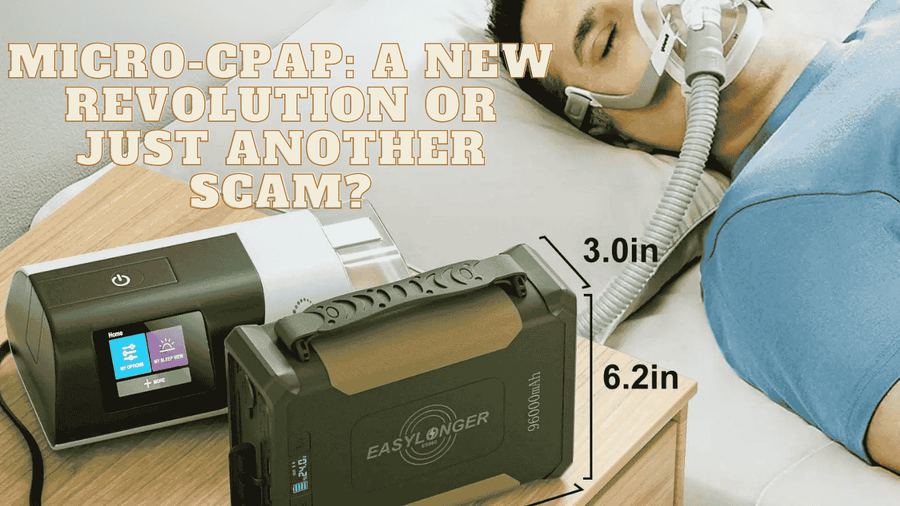 CPAP & sleep health
Micro-CPAP Claims: What to Verify Before Buying
Learn what to check behind micro-CPAP claims and how a documented travel CPAP system differs from a battery that powers your existing machine.
Jan 19, 2025