

Micro-CPAP Claims: What to Verify Before Buying
Learn what to check behind micro-CPAP claims and how a documented travel CPAP system differs from a battery that powers your existing machine.
By EASYLONGER · Jan 19, 2025 ·
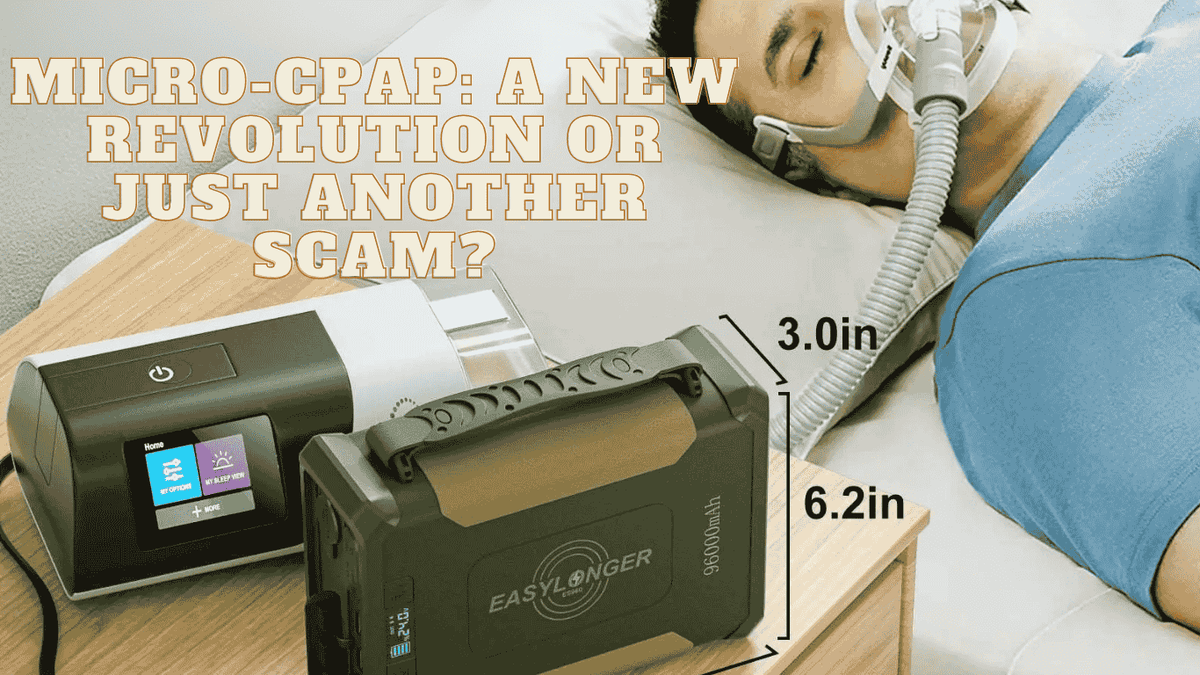
Quick answer: Use this guide for education and for preparing questions for your clinician. Sleep-apnea symptoms, diagnosis, PAP settings, and treatment decisions should be reviewed with a qualified healthcare professional.
Use the article as a conversation guide
Note the symptoms, equipment issues, or questions that apply to you, then review them with your clinician or equipment provider. Individual treatment decisions depend on your diagnosis and prescribed setup.

Obstructive sleep apnea (OSA) is a common problem where your throat muscles relax during sleep, making it hard for you to breathe properly. One common treatment for this is Continuous Positive Airway Pressure (CPAP) therapy. CPAP machines use a mask or nosepiece connected to a tube to blow air into your airway, keeping it open so you can breathe normally. CPAP machines are very effective, but they can be bulky, uncomfortable, and noisy. Many people have been hoping for a more convenient solution.
Recently, some companies have been promising a small, easy-to-use “micro-CPAP” device. These devices claim to provide the same benefits as a CPAP machine but in a much smaller, more portable design. But is this a breakthrough, or is it just another scam taking advantage of people’s struggles with sleep apnea?
The Dream of Micro-CPAP
Micro-CPAP devices promise to make treating sleep apnea easier. They claim to be small, disposable, and inexpensive. The idea is to create a device that you can insert into your nose, eliminating the need for bulky masks and tubes. Some of these devices even promise to provide enough airflow pressure to treat sleep apnea while being small and cheap.
It sounds almost too good to be true, right? Well, it might be.
What a small device still needs to prove
A device advertised as “micro-CPAP” needs evidence that it can deliver the prescribed pressure and airflow reliably throughout sleep. Size alone does not establish effectiveness. Ask for the exact manufacturer, model, regulatory status for your country, and clinical evidence for the claimed use.
Check the complete power and comfort system
Battery capacity, airflow control, mask fit, and humidification all affect how a system works. Published operating time should name the test conditions. A tiny fan or disposable battery is not proof that a product can replace your prescribed CPAP, and a generic minimum battery weight is not a reliable way to judge it either.
Separate a proposal from a supplied medical device
A crowdfunding page, promotional animation, or low per-use price is not the same as a device with published instructions and an established support route. Before spending money, confirm whether the exact product is available, what is included, and how returns and support work.
Small travel CPAP and “micro-CPAP” are different
Established travel CPAP devices still use a documented breathing system and machine-specific accessories. For example, ResMed AirMini uses compatible masks, tubing, and optional model-specific waterless humidification. Do not assume an unrelated nose-insert product has equivalent performance.
A Better Option for CPAP Users
If you already have a prescribed CPAP machine, an EASYLONGER CPAP battery can provide backup power for a compatible setup. EASYLONGER supplies batteries, not CPAP machines. Match the exact machine and cable, then test your normal overnight use before relying on the battery for travel or an outage.
A compact appearance is not evidence that a device can replace your prescribed PAP therapy. Verify the exact product’s authorization, clinical evidence and suitability with your clinician. A CPAP battery supplies power to a compatible machine; it is not itself a treatment device.
When to involve your care team
Contact your sleep clinician or equipment provider if symptoms continue, your mask leaks, treatment feels uncomfortable, or you are considering pressure or therapy changes. Do not use a blog post as a substitute for diagnosis or individualized medical advice.
Continue learning
Review the sleep-apnea library and the CPAP-therapy library for related education and practical questions to discuss with your care team.
Run the numbers for your CPAP.
Pick your machine and settings. The calculator shows nights for every battery.
Keep reading
 CPAP & sleep health
CPAP Guide: The Key to Better Sleep Quality
Review CPAP equipment basics and the role of a compatible ES960 backup battery for home outages and off-grid use.
Mar 14, 2025 CPAP & sleep health
What is a CPAP Machine? Everything You Need to Know
Learn how a CPAP machine keeps the airway open, how its main components work, and where compatible backup power fits into your routine.
Feb 20, 2025 CPAP & sleep health
The Top Sleep Apnea Apps You Might Be Overlooking
Compare sleep-tracking and CPAP companion apps, understand what their scores mean, and learn which information is useful to discuss with your clinician.
Jan 2, 2025