

CPAP Battery Backup: The Complete Guide for 2026
Choose a CPAP battery backup by exact machine requirements, cable and tested runtime. Compare options for outages, camping, road trips and air travel.
By EASYLONGER · Apr 8, 2026 ·

Need a CPAP battery backup? Start with the exact machine, cable and use case in our CPAP Battery Backup guide for travel, camping, outages and compatibility checks.
Quick answer: Choose a CPAP battery backup using the exact PAP model, the manufacturer-documented power path, the correct cable and runtime verified under the settings you actually use. Watt-hours are a planning input, not a runtime promise. Test the complete setup safely before relying on it. If flying, check the watt-hour rating printed on the battery and confirm the policy of every operating carrier on your itinerary.
A power interruption can disrupt prescribed PAP therapy. A CPAP battery backup provides another power option when wall power is unavailable, but the right setup depends on the exact machine, cable, battery output and tested runtime conditions. Discuss personal medical risks and contingency planning with a sleep clinician or equipment provider.
Scope: This guide covers CPAP and APAP backup planning. It is not a substitute for a professionally specified backup for a ventilator, life-support device or anyone who cannot safely tolerate a brief power interruption. Follow the device manual and the treating clinician’s contingency plan. Ask the clinician about medical risk or therapy settings; ask the manufacturer or equipment provider about the electrical connection and device setup.
This guide explains how to compare backup power for home outages, camping, RV travel and passenger-aircraft planning without treating a capacity number or compatibility label as a guarantee.
Why CPAP users plan for backup power
Backup planning starts with the situation you are preparing for. The same battery may be suitable for a short home interruption but unsuitable for a multi-night campsite or passenger flight.
- Home outages: confirm the battery can support the complete bedside setup and understand what pass-through charging does—and does not—guarantee.
- Camping, RVs and cabins: plan the required nights, recharge route, temperature and comfort settings.
- Air travel: use the watt-hour rating printed on the battery and the rules of every operating carrier.
- Destination backup: keep the correct cable and a tested recharge plan with the battery.
The useful question is not simply “Which battery is biggest?” It is “Which complete setup has been verified for my machine, normal settings and situation?”
How CPAP battery backup works
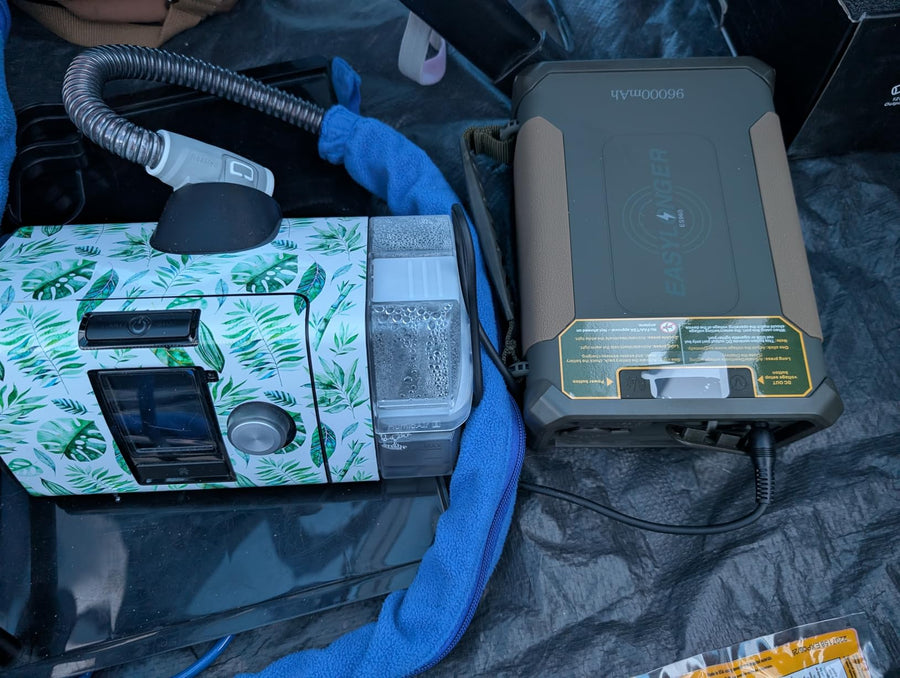
A CPAP battery backup is an external battery power source used to operate a compatible PAP setup when wall power is unavailable. Depending on the product, it may provide model-specific DC, USB-C PD or AC output. The correct route depends on both the battery and the PAP device.
Many PAP devices use an external AC adapter that supplies DC to the machine, but voltage, connector geometry, polarity, current capacity and device identification can differ by model. A manufacturer-documented direct-DC route can avoid an AC inverter stage, but compatibility and net efficiency must still be verified for the complete battery, output, cable and PAP setup.
Watt-hours and real runtime
Watt-hours (Wh) describe stored energy. All else being equal, a higher Wh rating provides more stored energy, but actual PAP runtime also depends on usable battery capacity, conversion losses and the complete overnight load.
A planning estimate can start with usable watt-hours divided by the measured power draw of the complete setup. Pressure, mask leak, humidification, heated tube, room temperature, battery condition and the AC or DC connection route can all change the result. Use the CPAP runtime calculator as a planning aid, not a promise, and keep a reserve.
Humidification and heated tube can materially increase power demand. Reducing optional comfort heat may extend runtime only when the change is permitted by the device instructions and appropriate for the user’s therapy. Do not change prescribed pressure settings to extend battery life.
Choosing the right CPAP battery: what to check
1. Exact PAP model and documented power path
Similar machine names can require different supplies, connectors or cables. Record the complete model name and read the Output line on the original power adapter—not the wall-input line. Then match the exact battery model, output setting and documented cable.
A connector that fits is not enough. Matching voltage alone does not establish compatibility; polarity, current capacity, startup behavior and any model-specific identification also matter. Use the EASYLONGER compatibility guide as a starting route and contact support with clear label photos when the exact combination is uncertain.
2. Capacity and measured runtime
Do not choose from a night-count label alone. Compare the printed Wh rating, usable output path, recharge options and a measured test using the pressure and comfort settings normally used. A published “typical” or “peak” power figure is not the same as measured overnight battery draw.
3. Chemistry, charging and operating limits
Battery chemistry affects weight, rated cycle life, charging behavior and operating limits. Compare the current manual for the exact battery instead of applying one cycle-life or safety claim to an entire product family.
4. Pass-through charging versus UPS operation
Pass-through charging means a battery can receive power while supplying a connected device. It does not by itself establish zero-transfer-time or uninterrupted UPS operation. Whether a PAP machine continues through an input-power interruption depends on the exact battery, input and output route, PAP device, cable, load, battery state and measured transfer behavior.
Do not describe a setup as uninterruptible unless that exact combination has been tested under documented conditions. Also check whether the charger can cover the connected load; in some pass-through arrangements the battery can discharge while wall power is still present.
5. Passenger-aircraft rules
For U.S. passenger baggage, EASYLONGER external CPAP batteries are handled as spare lithium batteries or power banks, not as batteries installed in a CPAP. The printed Wh rating determines the starting category, while the operating carrier makes any required approval decision. “TSA approved,” “FAA approved” and “airline approved” are not product certifications.
CPAP compatibility: verify the complete setup
Machine names alone do not confirm battery compatibility. These examples show why model-specific verification matters:
- ResMed AirSense 11, AirSense 10 and AirMini: these are separate 24V machine-specific paths with different supplies, connectors and accessories. A 12V source can be an input to a model-specific converter; that does not make the AirMini itself a 12V machine.
- Philips Respironics DreamStation: the first-generation DreamStation has a manufacturer-documented 12V accessory route. DreamStation 2, DreamStation Go and other configurations require separate specifications and testing.
- ResMed S9: the 30W and 90W supply options are different, and the manufacturer’s S9 converter is model-specific.
- React Health Luna G3 APAP (LG3600): the U.S. manual does not publish enough information to infer an external-battery direct-DC route from the machine name alone. The manual’s 24V/18W figure applies to the heated-tubing communications port, not the main-device input.
- BMC G3 A20/C20: BMC separately lists a 24V/3.33A main-device input. That BMC specification must not be transferred to React Health models.
Manufacturer documents describe the manufacturer’s own supplies or specifically named accessories. They do not establish approval of an EASYLONGER cable. Confirm the exact combination in the current battery documentation or with EASYLONGER support before connection.
An EASYLONGER cable listing documents the combination at the EASYLONGER evidence level; it is not approval from the PAP manufacturer. A model-family entry in a selector is only a planning route. Final confirmation should identify the exact battery, PAP model, adapter label, output setting, cable and any model-specific test record.
A safer test sequence
- Confirm that the exact battery manual supports the intended input and output combination.
- Use the documented machine-specific cable and correct output setting.
- Fully charge the battery and place it on a dry, stable, ventilated surface.
- While awake and able to restore wall power immediately, confirm that the PAP starts and runs normally.
- If evaluating pass-through backup, conduct a brief, controlled loss-of-input test and check whether the PAP continues, restarts, alarms or displays an error.
- Only perform a longer runtime test with another suitable power option immediately available and when a temporary interruption would not create a medical risk. Ask the treating clinician or equipment provider if unsure.
Compare EASYLONGER models by the real setup
Start with the exact PAP model and situation, then compare capacity, printed label, cables, recharge route and a measured runtime test.
ES270 - 99.9Wh
Planning role: Compact one-night and air-travel planning when the exact CPAP setup is compatible.
U.S. passenger-aircraft note: Within the ≤100Wh size category. Carry-on only as an external battery; protect against damage and short circuit and confirm the operating carrier’s policy. This is not TSA, FAA or airline approval.
ES400 AIR - 148Wh
Planning role: Light emergency, road and destination backup.
U.S. passenger-aircraft note: In the >100Wh to ≤160Wh category. Advance approval from every operating carrier is required; carry-on only, with no more than two individually protected spare batteries in this size range per person.
ES720 family - over 160Wh
Planning role: Weekend, camping, RV and home-outage planning.
U.S. passenger-aircraft note: Not permitted as ordinary passenger carry-on or checked baggage. Plan for ground-based use.
ES960 family - 297.6Wh
Planning role: Higher-reserve home, camping and repeated-outage planning.
U.S. passenger-aircraft note: Not permitted as ordinary passenger carry-on or checked baggage. For LiFePO4 variants, that chemistry is still treated as lithium ion under these carriage rules; plan for ground-based use.
Always use the Wh rating printed on the battery in front of you. Product specifications, carrier policies and international rules can change.
How to test a CPAP battery backup safely at home
A model whose current manual supports pass-through charging may be evaluated for home backup. Pass-through support alone does not establish zero-transfer-time or uninterrupted operation.
- Read the current manual for the exact battery model and confirm the supported pass-through input and output combination.
- Confirm the exact PAP model, original-adapter output, cable and battery output setting.
- Fully charge the battery. Check that the documented charger can support the connected load and monitor whether the battery percentage falls during normal use.
- While awake and able to restore wall power immediately, perform a brief input-loss test.
- Record whether the PAP continues, restarts, alarms, errors or needs reconnection. Do not call the setup uninterruptible if any restart or interruption occurs.
- If a longer test is appropriate, keep another suitable power option immediately available and retain a reserve rather than running the battery to zero.
Use the model-specific video library only after matching the exact battery and PAP. The current manual—not a visually similar video—controls voltage, cable, charging and safety limits.
Flying with a CPAP battery: U.S. FAA/DOT rules
Under 49 CFR §175.10(a)(18), external batteries whose primary purpose is to power another device are handled as spare batteries or power banks. For U.S. passenger baggage:
- Up to and including 100Wh: may be carried in carry-on baggage subject to applicable battery-testing, condition, packing, airline and security-screening requirements. Do not put the external battery in checked baggage.
- Over 100Wh and up to and including 160Wh: requires approval from the operating carrier. No more than two individually protected spare batteries in this size range may be carried per person, and they are carry-on only.
- Over 160Wh: standalone EASYLONGER CPAP batteries are not permitted in ordinary passenger carry-on or checked baggage. Separate mobility-aid rules do not apply to a standalone CPAP power bank.
- All permitted spare batteries: protect them from damage and short circuit. If a carry-on bag is gate-checked, remove the battery and keep it in the cabin. Do not travel with a damaged or recalled battery.
A battery installed in a portable electronic device can have different checked-baggage conditions. That installed-device exception does not apply to EASYLONGER external CPAP batteries. Each battery type must also have passed applicable UN 38.3 transport testing; a test report does not guarantee TSA screening or airline acceptance.
These are U.S. rules. International authorities and airlines may be more restrictive. For codeshare or multi-carrier travel, identify and confirm every operating carrier for every flight segment.
Can I operate a PAP machine during a flight?
Policies and permitted equipment vary. Ask the operating carrier before travel, follow crew instructions, and do not assume that seat power will be available or suitable.
How should I choose a battery?
Confirm the exact PAP model, voltage, connector, normal settings, printed watt-hour rating, carrier rules, and a measured runtime test. Keep a reserve margin.
Is a battery “TSA approved” because it is under 100Wh?
No. A battery can fall within a U.S. size category, but that is not a TSA, FAA or airline product approval. TSA conducts security screening; FAA/DOT rules and the operating carrier’s policy govern carriage conditions.
What should I do if the battery or PAP fails during a trip?
Contact the equipment provider or treating clinician for therapy guidance. For EASYLONGER battery support, email support@easylonger.com with the model, setup, display status and clear photos or video.
Before you travel
- Confirm the exact PAP and battery model.
- Photograph the battery’s printed Wh rating and the PAP adapter’s Output line.
- Use the documented cable and test the complete setup while awake.
- Keep a suitable backup power option and a realistic reserve.
- Check the current policy of every operating carrier and request written approval when required.
- Carry permitted external batteries in the cabin with terminals protected.
- Remove the battery before a carry-on bag is gate-checked.
- Do not carry a damaged, swollen or recalled battery.
Continue planning
Turn the guide into a tested plan with the exact machine, cable and settings:
- Check CPAP compatibility
- Estimate runtime and review the assumptions
- Compare EASYLONGER battery families
- Open manuals, flight documents and product support
Sources and review date
Fact-checked against manufacturer documentation and current U.S. FAA/DOT guidance on September 3, 2026. Regulations, carrier policies and product specifications can change; recheck before relying on them.
- FAA: Airline Passengers and Batteries
- FAA PackSafe: Lithium Batteries
- 49 CFR §175.10
- IATA: Lithium-battery chemistry and transport classification
- ResMed AirSense 11 User Guide and Air11 DC/DC Converter Guide
- ResMed AirSense 10 User Guide and Air10 DC/DC Converter Guide
- ResMed AirMini User Guide and AirMini DC/DC Converter Guide
- Philips DreamStation CPAP User Manual and HH1422/00 12V DC Cord
- ResMed S9 Information Guide and S9 DC/DC Converter Bulletin
- React Health Luna G3 APAP LG3600 User Manual
- BMC Download Center: G3 Series User Manual
- EASYLONGER ES270 User Manual, ES400 AIR User Manual, ES720 PRO User Manual, ES960 User Manual and ES960 PRO User Manual
Run the numbers for your CPAP.
Pick your machine and settings. The calculator shows nights for every battery.
Keep reading
 Buying guides
CPAP Battery Guide: Choose Backup Power
Choose a CPAP battery around your machine, cable, comfort settings and recharge access. Compare capacity and travel limits before buying.
Sep 7, 2026 Buying guides
Just Diagnosed with Sleep Apnea? Here’s What You Need to Know About CPAP Batteries
New to CPAP batteries? Compare compatibility, capacity, charging and included cables before preparing for an outage or trip.
Nov 30, 2025 Buying guides
EASYLONGER ES720: CPAP Battery Backup for Home and Camp
Explore ES720 capacity, included cables and charging options for a familiar, tested CPAP backup setup at home or on the road.
Mar 19, 2025