

Why You Need a CPAP Battery for Air Travel
Plan CPAP power for a flight with measured runtime, a matching cable and advance carrier approval for batteries over 100Wh up to 160Wh.
By EASYLONGER · Apr 23, 2025 ·

Quick answer: Check the battery’s watt-hour rating before you pack. Spare lithium batteries and power banks belong in carry-on baggage; airline approval and quantity limits can apply, so confirm the current rule with your carrier before departure.
Start with the watt-hour rating
The watt-hour value printed on the battery determines which airline rules apply. Battery size, carry-on placement, terminal protection, and carrier approval should be checked before every trip.

Most airlines do not guarantee outlet access. Some carriers ask travelers using medical devices to carry additional battery capacity, so check the operating carrier’s accessibility and medical-device policy before departure. For example, if your carrier requires reserve equal to 150% of flight time, a six-hour flight calls for at least nine hours of CPAP runtime. Apply the actual carrier’s rule to your itinerary.
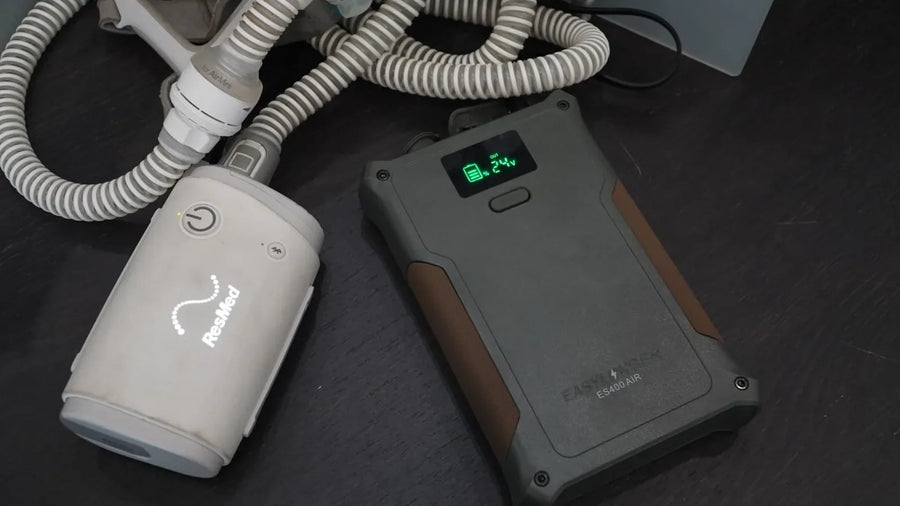
FAA guidance separates spare lithium batteries into 0–100Wh and 101–160Wh categories; the larger category requires carrier approval, which covers most CPAP-specific portable batteries like the EASYLONGER ES400 AIR.
CPAP Batteries and Springtime Travel
Spring storms can trigger outages, and RV or cabin trips often lack reliable power. A portable CPAP battery keeps therapy running off-grid and serves as a home backup.
Choosing the Right CPAP Battery: What to Look For
- Flight planning: ≤100Wh or >100Wh to 160Wh with advance carrier approval; permitted external batteries stay in carry-on.
- Compatibility: Works with leading models (ResMed, Philips, etc.).
- Capacity: enough measured runtime for your sleep window and reserve; some setups can use less than 100Wh.
- Fast recharging: AC, car, solar.
- Pass-through support: verify the permitted connection and changeover behavior.
- USB-C/USB-A ports for other devices.
- BMS safety: Overcharge, short-circuit, temperature protection.
- HSA/FSA reimbursement: check eligibility and required documentation with your plan administrator.
Don’t Let CPAP Limit Your Lifestyle
About 30 million Americans have sleep apnea, yet many avoid trips or flights over therapy worries. With a dependable travel CPAP battery, you can keep flying, camping, and visiting family without sacrificing sleep health.
Our Recommendation: EASYLONGER ES400 AIR CPAP Battery
- 148Wh capacity: advance operating-carrier approval is required under U.S. rules.
- Pass-through charging for backup-power planning for prescribed therapy.
- Four CPAP cables included: ResMed S9, AirSense 10, AirCurve 10, AirSense 11, AirMini, Philips DreamStation/2.
- Three recharge options: AC, car, or solar (panel not included).
- USB-C, USB-A, and 160W car socket for other devices.
- Built-in protections via BMS.
Whether you are flying, camping, or preparing for outages, the ES400 AIR is compact, powerful, and ready for travel.
Before you travel
- Confirm the watt-hour rating printed on the battery.
- Carry spare lithium batteries and power banks in carry-on baggage.
- Protect exposed terminals and keep the battery accessible.
- Ask the airline for written approval when its rules require it.
Important: U.S. FAA guidance and airline policies can change, and international rules may differ. Check the current requirements for every carrier on your itinerary.
Continue planning
Use the CPAP travel-battery guide for a complete packing workflow, or review the 99.9Wh ES270 travel battery when a compact carry-on option fits your machine.
Check the current flight rule
For U.S. departures, review the FAA PackSafe battery guidance, then confirm the operating carrier’s policy for every flight segment. Spare lithium batteries and power banks must be protected from damage and short circuits and kept in carry-on baggage under the applicable limits.
Run the numbers for your CPAP.
Pick your machine and settings. The calculator shows nights for every battery.
Keep reading
 Setup & care
ResMed AirMini Battery Guide for Runtime and Travel
Choose an AirMini battery by its documented 24V cable path, tested reserve and trip rules. Separate battery carriage from permission to use the kit in flight.
Sep 24, 2026 Travel & flying
2026 Guide to Traveling and Flying with Your CPAP Machine
Prepare your CPAP machine, battery, cables and documents for a flight. Check carrier rules and test the setup before leaving home.
May 5, 2026 Travel & flying
Planning a Trip? Don't Forget Your CPAP and Battery Backup
Pack a tested CPAP battery setup for travel. Review ES400 AIR cables, charging and the airline approval required for its 148Wh capacity.
Dec 7, 2025