

Stay Powered Up: Your Guide to CPAP Battery Solutions for Travel
Build a travel-ready CPAP kit around ES400 AIR compatibility, charging options, included cables and current airline requirements.
By EASYLONGER · Mar 6, 2025 ·

Quick answer: Check the battery’s watt-hour rating before you pack. Spare lithium batteries and power banks belong in carry-on baggage; airline approval and quantity limits can apply, so confirm the current rule with your carrier before departure.
Start with the watt-hour rating
The watt-hour value printed on the battery determines which airline rules apply. Battery size, carry-on placement, terminal protection, and carrier approval should be checked before every trip.

Traveling with a CPAP means better sleep wherever you go. But when you are miles from an outlet—camping, flying long-haul, or facing a sudden outage—a reliable CPAP battery becomes your travel hero. Here is how to keep therapy running smoothly off the grid.
Why a CPAP Battery is a Travel Must-Have
Electricity is not guaranteed on the road. A portable CPAP battery can help keep a compatible machine powered for your tested travel interval.
Key scenarios where a CPAP battery shines:
- Camping or RV trips (no outlet needed).
- Long flights (in-seat power is not guaranteed).
- Power outages at hotels or rentals.
- Road trips with limited charging options.
Choosing the Right CPAP Battery for Your Needs
Look for:
- Long runtime: Power for multiple nights.
- Lightweight design: Easy to pack.
- Compatibility across many supported setups after model, voltage, and cable confirmation: Matches your CPAP model.
- Safety certifications: Guards against overheating/short circuits.
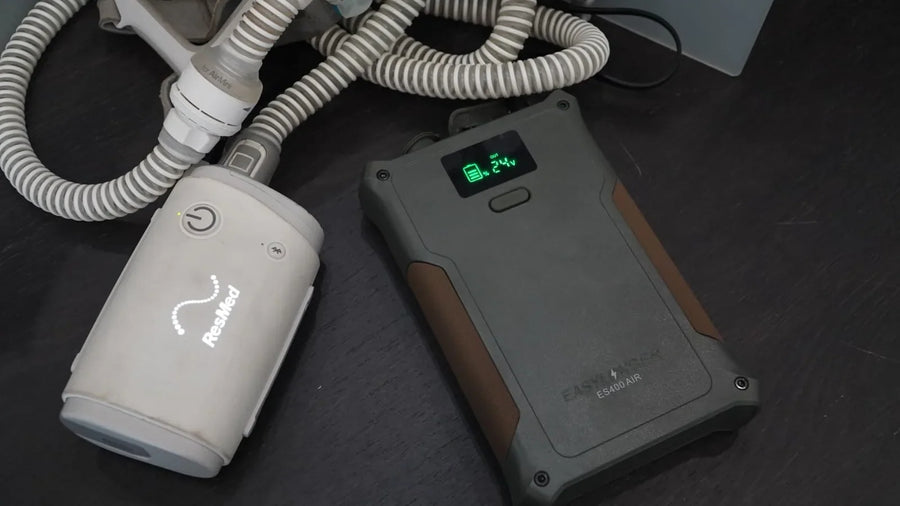
The EASYLONGER CPAP Battery ES400 AIR (148Wh) can support compatible CPAP backup planning; test the exact machine and normal settings before travel. Compact for travel and compatible with ResMed AirSense 10/11, AirMini, Philips DreamStation, and more.
How to Maximize Your CPAP Battery Life
Stretch every charge with smart habits:
- If appropriate for your therapy, compare your normal heat settings with a lower-heat setup at home; keep prescribed pressure unchanged.
- Select the documented output voltage and cable for the exact CPAP before connecting it.
- Charge fully before your trip.
- Pack a solar panel for off-grid recharging.
The EASYLONGER ES400 AIR offers three recharge options: wall outlet, car charger, or solar (sold separately). It includes four DC cables for ResMed and Philips devices—the matching cable is included for those listed connections. Check other models and accessories separately.
Safety First: What to Look for in a CPAP Battery
Safety matters with lithium batteries. The ES400 AIR features a Battery Management System (BMS) to prevent overcharge, over-discharge, and short circuits. It is designed to stay cool and stable—ideal for seniors or first-time users.
Bonus: More Than Just a CPAP Battery
A good CPAP battery also charges your other devices. The ES400 AIR includes a 160W car socket, 30W USB-C, and 18W USB-A ports to power phones, laptops, or a camping fan—no extra gadgets needed.
Final Tips for Stress-Free Travel
- Test your battery at home before departure.
- Pack distilled water or plan to buy on arrival.
- Bring a backup mask in case of emergencies.
- Keep your CPAP and documentation easy to present at screening; a label does not guarantee faster screening.
Ready for the Trip
A CPAP battery makes travel simpler. From campfires to 12-hour flights, plan your sleep window using measured runtime and the carrier’s in-flight requirements.
Safe travels and sweet dreams from EASYLONGER.
Before you travel
- Confirm the watt-hour rating printed on the battery.
- Carry spare lithium batteries and power banks in carry-on baggage.
- Protect exposed terminals and keep the battery accessible.
- Ask the airline for written approval when its rules require it.
Important: U.S. FAA guidance and airline policies can change, and international rules may differ. Check the current requirements for every carrier on your itinerary.
Continue planning
Use the CPAP travel-battery guide for a complete packing workflow, or review the 99.9Wh ES270 travel battery when a compact carry-on option fits your machine.
Check the current flight rule
For U.S. departures, review the FAA PackSafe battery guidance, then confirm the operating carrier’s policy for every flight segment. Spare lithium batteries and power banks must be protected from damage and short circuits and kept in carry-on baggage under the applicable limits.
Run the numbers for your CPAP.
Pick your machine and settings. The calculator shows nights for every battery.
Keep reading
 Setup & care
ResMed AirMini Battery Guide for Runtime and Travel
Choose an AirMini battery by its documented 24V cable path, tested reserve and trip rules. Separate battery carriage from permission to use the kit in flight.
Sep 24, 2026 Travel & flying
2026 Guide to Traveling and Flying with Your CPAP Machine
Prepare your CPAP machine, battery, cables and documents for a flight. Check carrier rules and test the setup before leaving home.
May 5, 2026 Travel & flying
Planning a Trip? Don't Forget Your CPAP and Battery Backup
Pack a tested CPAP battery setup for travel. Review ES400 AIR cables, charging and the airline approval required for its 148Wh capacity.
Dec 7, 2025